Introduction
Indiana does not have a reputation as a destination. This is, on balance, Indiana’s gain — because it means that one of the most scenically bizarre and genuinely spectacular stretches of the southern Lake Michigan shoreline remains, relative to its quality, dramatically undervisited. Indiana Dunes National Park sits roughly an hour and a half southeast of Chicago, protects fifteen miles of Lake Michigan shoreline and a landscape of towering sand dunes, oak savanna, bogs, and wetlands, and produces views from its dune crests that will make you stop walking and just stare at the water in a way that would be entirely appropriate in coastal Maine or the Pacific Northwest and feels faintly impossible in Indiana.
The water is that colour. The dunes are that size. The climb is that steep. And yes, there is a power plant cooling tower visible from the beach in one direction, sitting in the middle of an otherwise pristine panoramic view like a guest who showed up to the wrong party and decided to stay anyway. Indiana Dunes contains multitudes. You will come to appreciate this about it.
This is not a manicured, interpretive-panel-every-hundred-metres kind of national park experience. It is sandy, physical, exposed on the dune crests, and delivers exactly the kind of view that makes you understand why people drove an hour and a half from Chicago to get here — and why they’ll do it again.
The Landscape: What You’re Actually In
Indiana Dunes is one of the more ecologically diverse national parks in the system, which is a sentence that surprises most people who think of it purely as “the big sand pile near Chicago.” The dunes themselves — some rising to nearly 200 feet above the lake — were formed by glacial activity and shaped by thousands of years of wind and wave action. The oldest dunes, further from the shore, have been colonised by successive plant communities in a process of ecological succession that botanists have been studying here since the late nineteenth century. The active dunes closer to the shoreline are still moving, still shifting, still burying and exposing the landscape in slow motion.
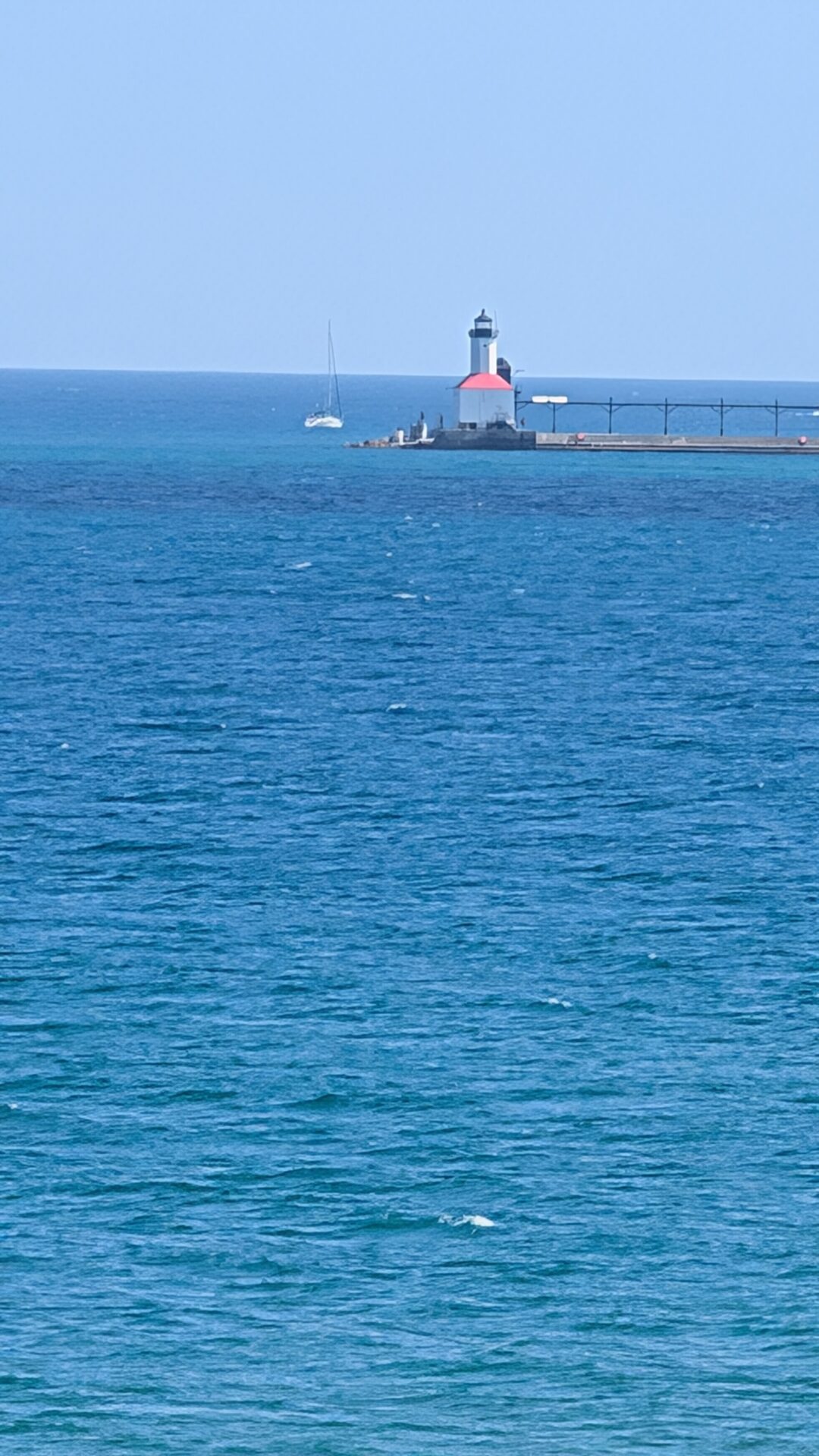
The Lake Michigan water is turquoise for the same reason it’s brilliant everywhere along the southern shore: depth, clarity, and the particular way this specific body of fresh water scatters light. From the top of a dune on a clear summer day, looking north across the water, you can convince yourself you’re looking at the Caribbean. You are not looking at the Caribbean. You are looking at Indiana. Both of these facts are simultaneously true.
The Hike: Up the Dunes and Down to the Water
The Dune Climb (The Part That Will Find Your Limits)
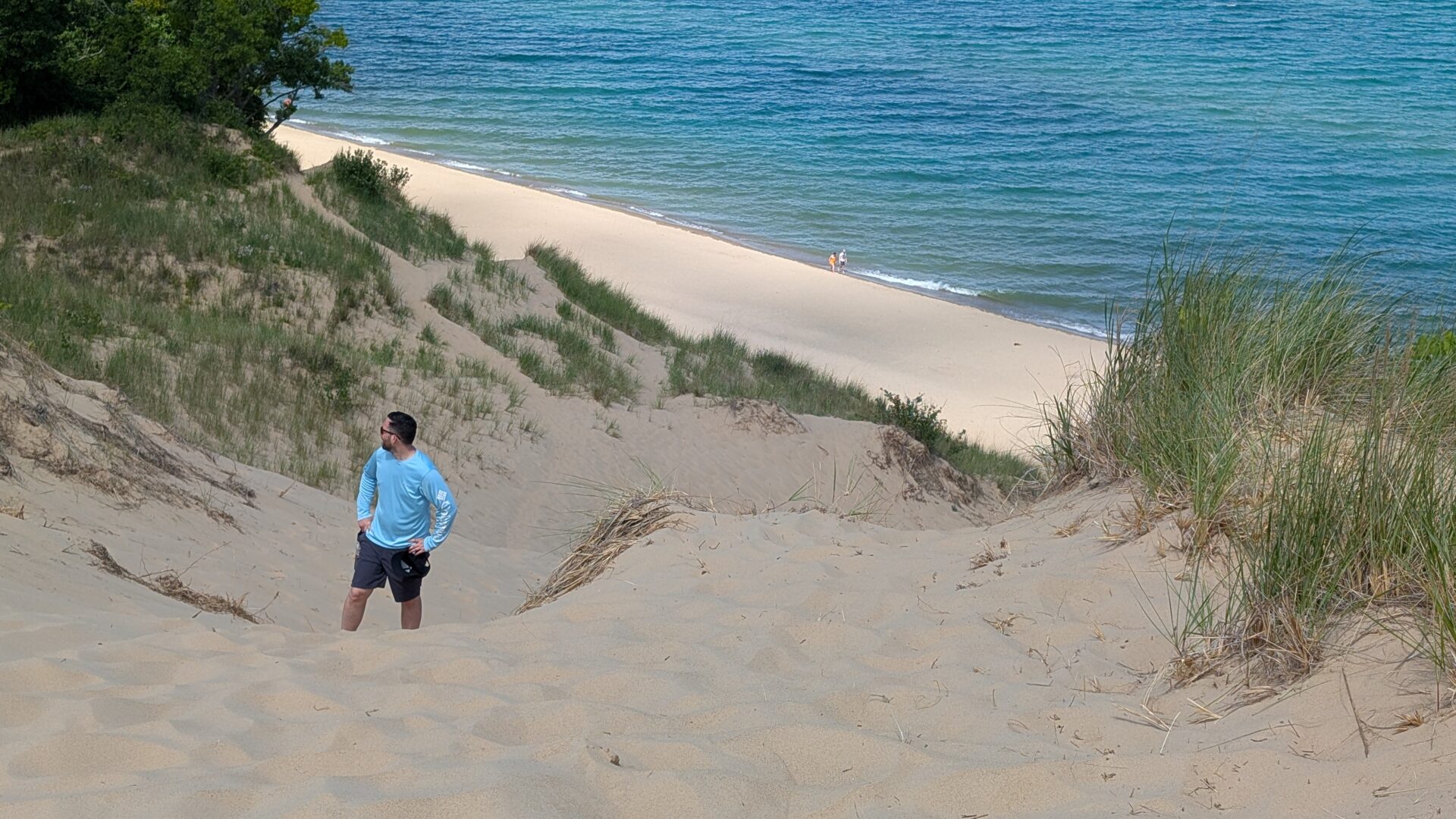
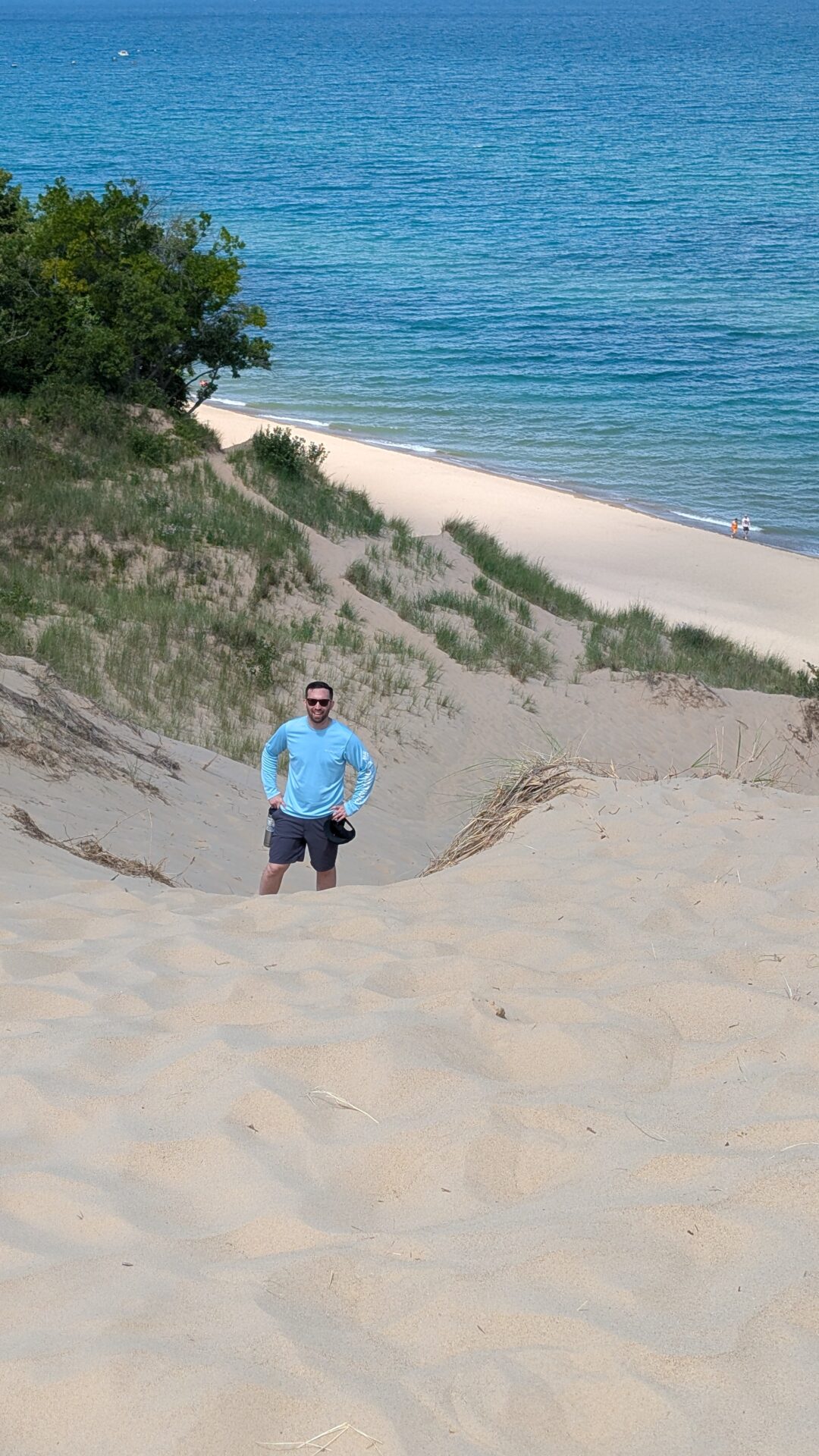
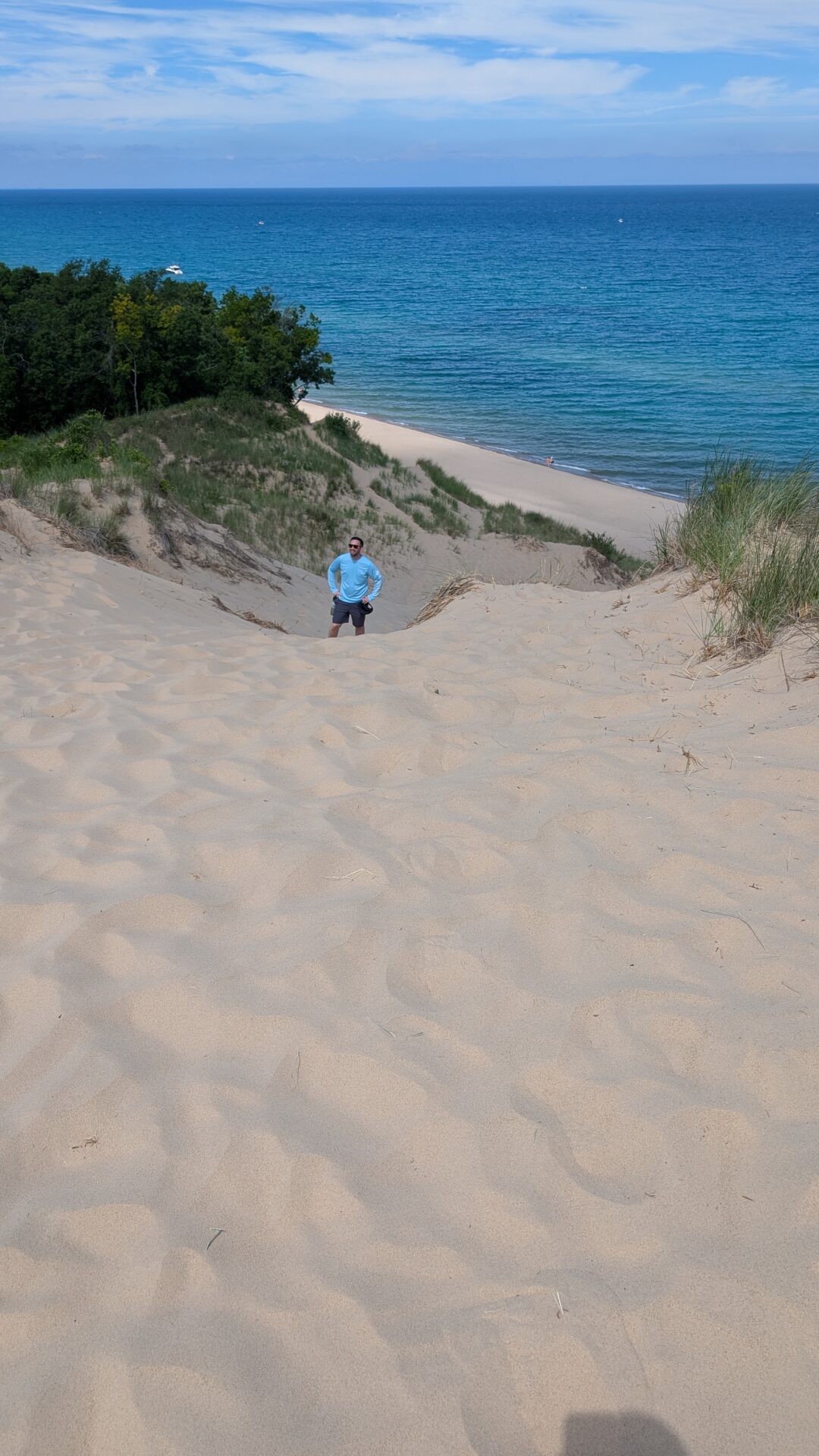
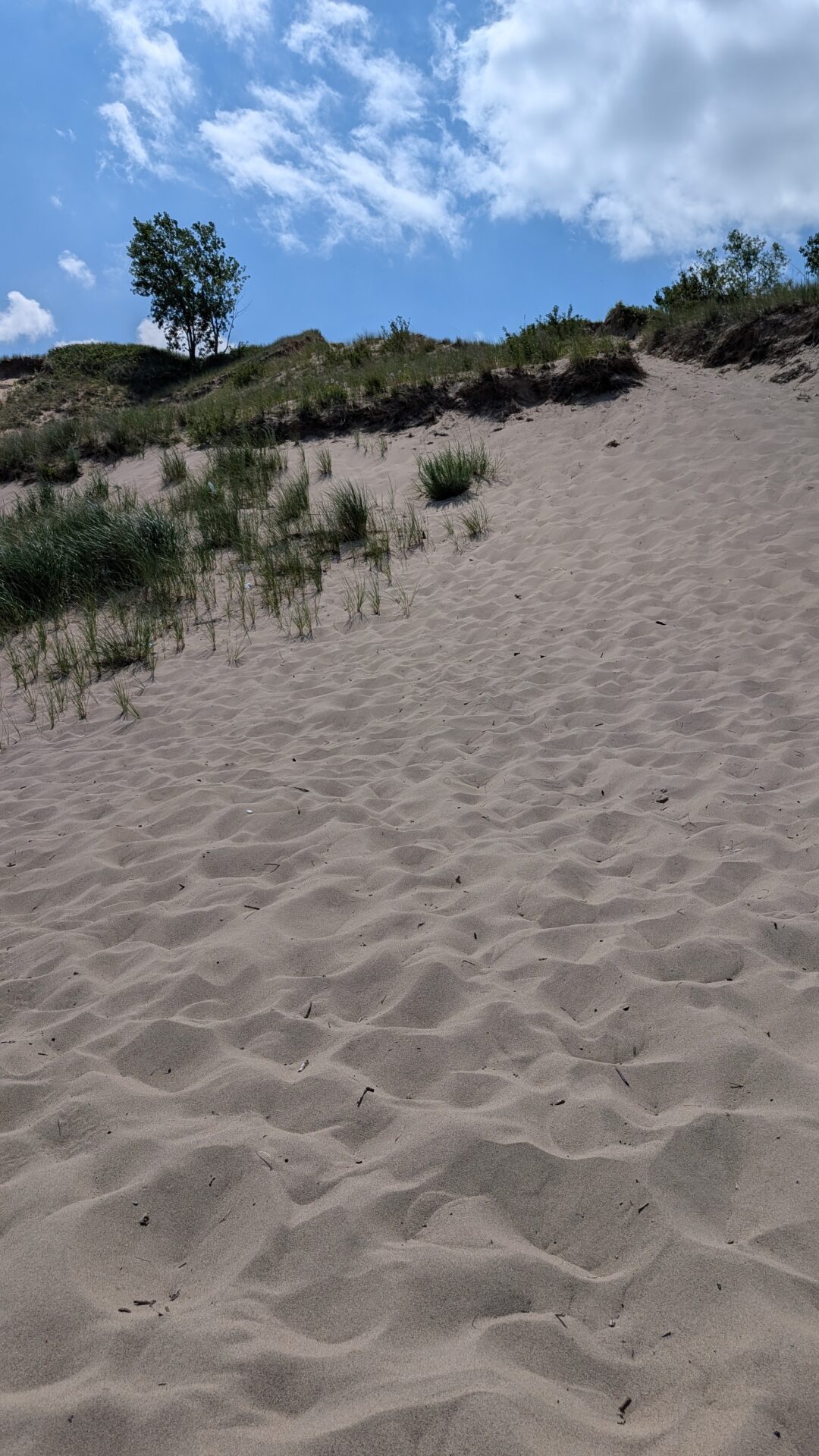
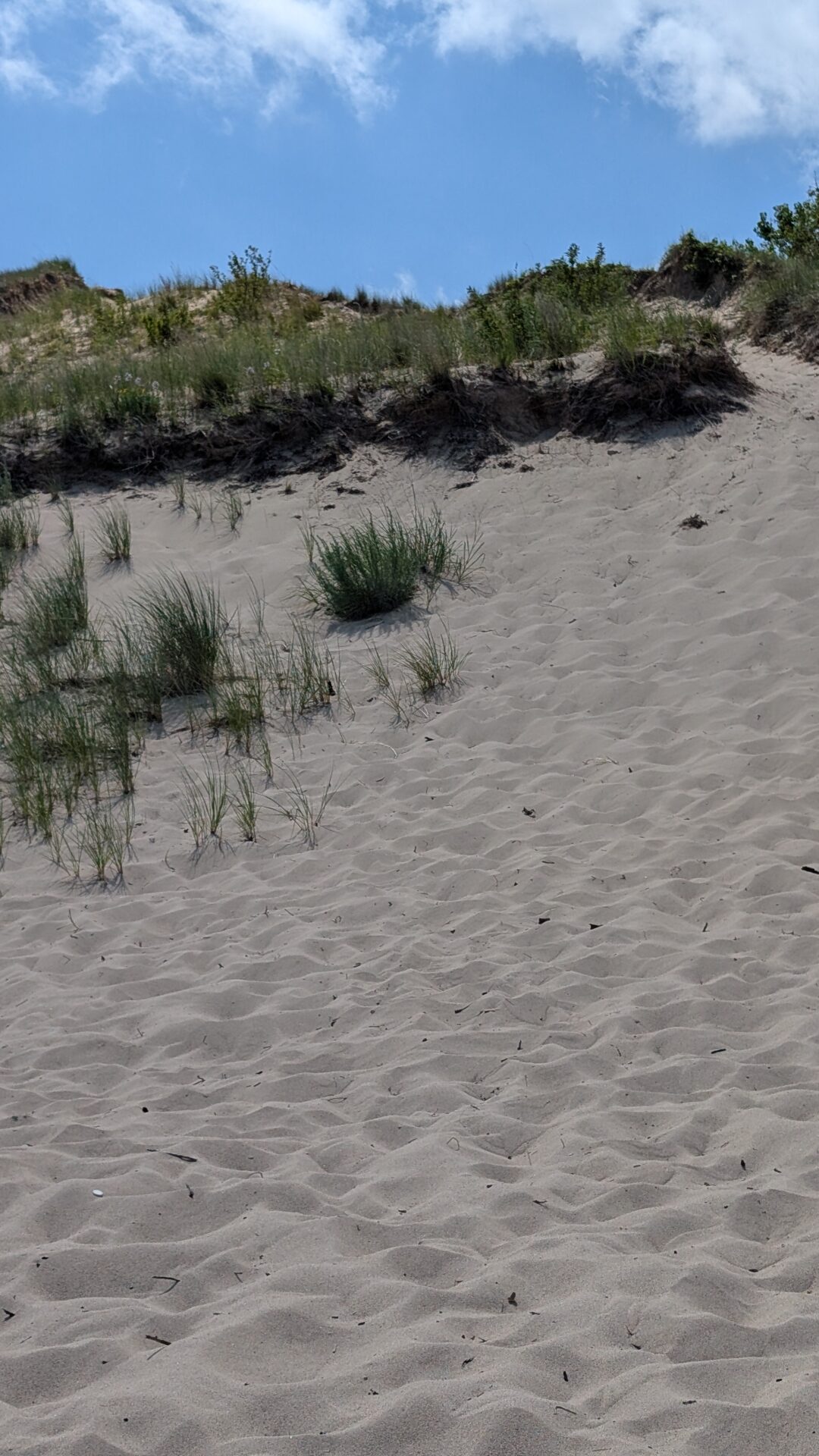
There is no gentle way to climb a sand dune. The surface gives under every step, your foot sinks an inch for every two inches of progress, and the grade — which looks manageable from the base and becomes clarifyingly steep once you’re on it — involves a sustained, quad-burning, slightly undignified upward movement that has very little in common with trail hiking and quite a lot in common with stair climbing on an unstable surface.
It is, as workouts go, outstanding. It is also, as views go, immediately and completely worth it.
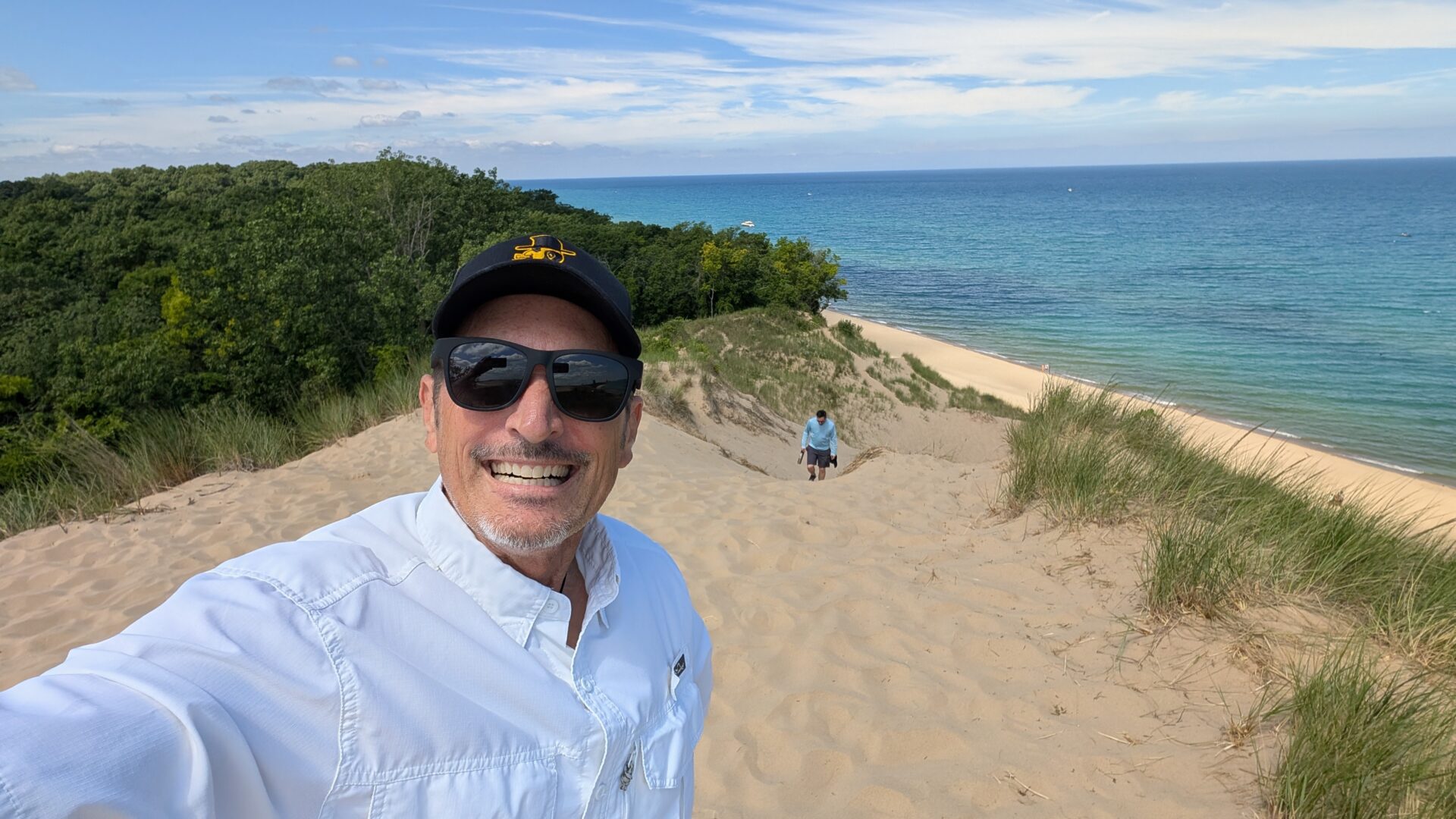
[Featured photo: Summit selfie on the dune crest — Lake Michigan turquoise and enormous behind, another hiker making the climb in the background, the beach curving away below. This is the view that justifies the sand in your shoes.]
The moment you reach the crest, everything changes. The lake opens up in front of you — that turquoise water, that impossible colour, that flat horizon — and below you the dune falls away steeply to the beach in a clean arc of pale sand. Running down is both permissible and extremely satisfying. Your knees will have opinions about the return climb.
The Panorama From the Top (Hold This View)
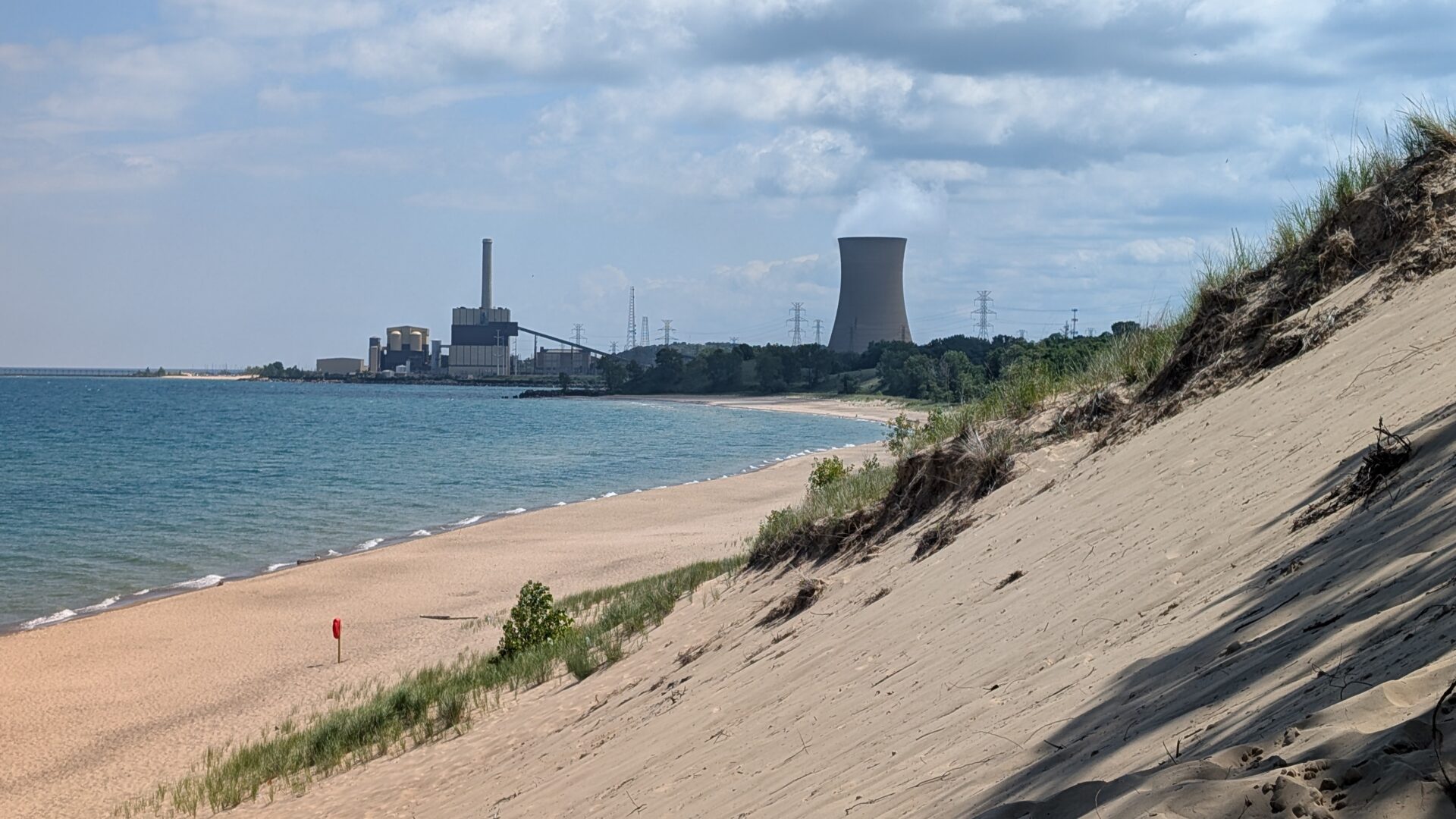
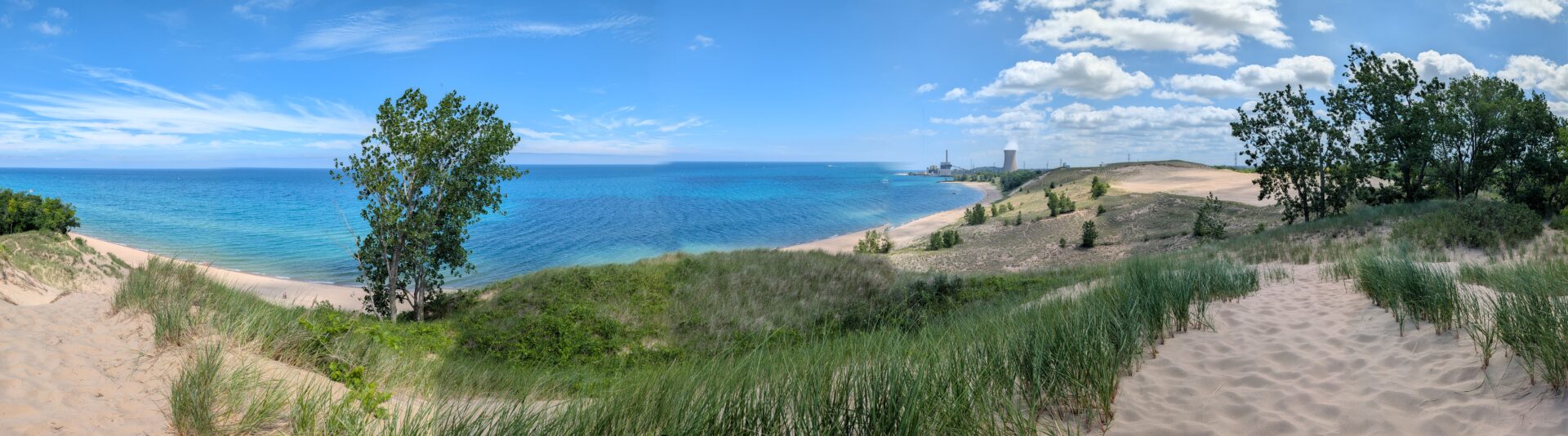
From the higher dune crests, the full scope of the landscape becomes visible in a way that the base doesn’t prepare you for: the beach curving in both directions, the lake running north to the horizon, the vegetated older dunes rolling inland, and — yes, directly in the sightline of the most spectacular part of the view — the cooling towers of the Midwest Generation plant, sitting on the shoreline with the complete serenity of something that has absolutely no self-awareness about its visual impact.
[Featured panoramic photo: The view from the dune crest — Lake Michigan in improbable turquoise from left to right, pale sand beach below, lush dune vegetation in the foreground, and the power plant cooling towers sitting unapologetically in the middle distance. Indiana Dunes in full.]
Here’s the thing about the cooling towers: they are, once you’ve accepted their presence, strangely compelling. They’re enormous. They produce their own weather system in the form of the steam plume that drifts off them on humid days. And the contrast between the industrial infrastructure and the national park landscape that surrounds it on three sides is so unlikely, so specifically American, so thoroughly Indiana, that the photograph that includes them is actually more interesting than the one that doesn’t.
Lean into it. Take the panoramic shot. Embrace the contradiction.
The Beach at the Base
Descend the dune face — running is the correct method, dignity optional — and you arrive on a beach that is, by any reasonable measure, extraordinary. The sand is pale and fine, the water is that turquoise, and the swimming is genuinely excellent in summer. Lake Michigan along this stretch runs clear over a sandy bottom and warms to comfortable swimming temperatures by July. People who have never been to Indiana Dunes and imagine a grey, industrial Great Lakes experience are genuinely unprepared for what the water looks like on a clear summer afternoon.
Spend time at the water. This is what you climbed for. Then acknowledge that you have to go back up.
Practical Details
Getting There
Indiana Dunes National Park is approximately 50 miles southeast of Chicago — roughly an hour’s drive depending on the inevitable Skyway traffic, or accessible by the South Shore Line commuter rail from Millennium Station to the Dune Park station. The rail option is underused and entirely viable for a car-free day trip.
Parking
Multiple park units have their own parking areas. For dune climbing, the main access points are:
- Dune Acres / Dunbar Beach area — access to active dune climbing
- West Beach — popular, well-facilitated, some of the best swimming, fills quickly on summer weekends
- Mount Baldy area — note that the Mount Baldy dune trail has had periodic closures due to tree burial hazards; check NPS website for current conditions before visiting
- Kemil Beach / Indiana Dunes State Park — the adjacent state park (separate from the national park) has additional dune access and facilities
The national park entry is free with an America the Beautiful pass; day use fees apply otherwise. On summer weekends, parking areas fill before 10am. Arrive early or take the train.
Entrance Fees
Check the NPS website for current fee information at nps.gov/indu. The park uses timed entry or fee systems for busy periods — verify before visiting in summer.
What to Pack
Sand dune hiking has its own specific packing logic:
- Water — substantially more than you think. The dune climbs are more physically demanding than their distance suggests, the surface is exposed and hot in summer, and there is no shade on the active dunes. Bring a litre per person minimum; more in heat.
- Sunscreen — aggressively applied. The dune crests are fully exposed and the reflective surface of the sand amplifies UV. Apply before you leave the car park and reapply after swimming.
- Closed-toe shoes you don’t mind filling with sand. Trail runners or old sneakers are ideal. Sandals are technically manageable on the beach but miserable on the dune climb. Do not wear anything with ankle exposure if you’re sensitive about sand.
- A bag for wet things — if you’re swimming, you’ll want somewhere for wet clothes that isn’t your main bag.
- Snacks and lunch — the park has limited concession options. Pack food. The beach at the base of the dunes is an excellent lunch location.
- A hat and sunglasses — the dune crests generate their own wind and the combination of sand, sun, and lake glare without eye and head protection is uncomfortable.
Seasonal Considerations
Summer (June–August): Peak season, warmest water, best swimming, most visitors. Parking fills early on weekends — arrive before 9am or take the train. The dune climbs in the July heat are a genuine cardiovascular event. Bring more water than feels necessary. The lake in summer is at its most Caribbean-coloured and the beach experience is as good as any freshwater swimming in the Midwest.
Autumn (September–October): The crowds thin after Labour Day and the temperatures moderate, making the dune climbs considerably more comfortable. The lake stays swimmable into September. The surrounding oak and maple woodland in the older dune sections turns in October and the colour combined with the sand and blue water makes for genuinely unusual and beautiful photography.
Winter (November–March): The park is open year-round and the winter dune landscape — bare-branched trees, ice formations along the shoreline, the lake steel-grey and restless — is worth seeing for people prepared for cold. The dune climbs in winter are actually easier because the sand firms up when cold and wet. Ice along the shoreline can be spectacular. Dress for sustained Lake Michigan wind exposure.
Spring (April–May): Wildflowers in the wooded dune sections, increasing bird activity along the shoreline, and none of the summer crowds. The lake is cold and not swimmable but the landscape is vivid and the park is at its quietest. One of the better birding seasons — the Indiana Dunes is a significant migratory stopover.
Common Mistakes to Avoid
- Underestimating the dune climb. It is short. It is steep. The sand gives underfoot in a way that doubles the physical effort of an equivalent slope on solid ground. This is not a casual stroll up a hill. Budget energy accordingly.
- Going on a summer weekend without arriving early. The parking situation is serious. The park is within day-trip range of Chicago, Gary, Indianapolis, and several other large metro areas. If you’re arriving after 10am on a Saturday in July, you’re gambling. Win this one by leaving earlier.
- Ignoring the cooling tower in your photos. It is there. It is large. It is not going anywhere. Accept it, photograph it, appreciate the wild specificity of a national park panorama that includes industrial infrastructure. It’s more honest than cropping it out.
- Not swimming. The water is that colour and that temperature and that clear. You are standing at the top of a sand dune above a beach on Lake Michigan. Go in.
- Only doing the active dunes. The park has 15 miles of shoreline and significant trail networks through the older vegetated dunes, wetlands, and savanna. The dune climbs are the headline act but the broader trail system has more variety than most visitors discover.
FAQs
Is Indiana Dunes worth visiting from Chicago? Unambiguously yes. It is 90 minutes from downtown and delivers a landscape — tall sand dunes, turquoise lake, wide beaches — that has no parallel this close to the city. It is also, for reasons that remain unclear, dramatically undervisited relative to its quality. Go.
What’s the best dune to climb at Indiana Dunes National Park? Several options depending on access: the dunes in the main park units near West Beach and the Dunbar/Dune Acres areas offer active dune climbing. Mount Baldy is the most famous individual dune but has had periodic closure for trail safety — check current NPS conditions. The state park adjacent to the national park also has excellent dune access.
Can you swim at Indiana Dunes? Yes, and you should. The lake is swimmable from late June through September, with water temperatures reaching comfortable levels in July and August. The beach at the base of the active dunes is among the better swimming spots in the park. Check for any water quality advisories before swimming — the NPS and Indiana DNR post these when relevant.
How difficult is the dune climbing? More difficult than it looks. The steep grade combined with the energy-absorbing sand surface makes the climb meaningfully harder than an equivalent slope on solid ground. Most reasonably fit adults will manage it; it will make them work. Children find the running descent extremely satisfying and the climbing character-building.
Is there a fee to enter Indiana Dunes National Park? Day use fees apply; the America the Beautiful annual pass covers entry. Check nps.gov/indu for current pricing and any timed entry requirements, which the park uses during peak season periods.
What about that power plant in the photographs? That’s the NIPSCO Michigan City Generating Station, visible from the beach and the dune crests to the east. It is large, it is operational, and it is genuinely part of the Indiana Dunes visual experience. The park was established in part because of the tension between industrial development and conservation along this shoreline — the cooling tower is, in a sense, the whole argument made visible. It doesn’t diminish the landscape. It contextualises it.
Conclusion: Indiana’s Best Answer to Every Assumption About Indiana
Indiana Dunes National Park is the park that surprises people. Not because the dunes aren’t famous — they are, among people who know them — but because the gap between what most visitors expect from a national park in Indiana and what they actually find when they climb to the crest of a sand dune and look north at that turquoise lake is so wide that it constitutes a genuine recalibration.
The dune climb is harder than it looks. The view from the top is better than it has any right to be. The water is genuinely, improbably, that colour. And the cooling tower in the background of the most spectacular panoramic view is either an eyesore or a defining feature of a landscape that refuses to be one simple thing — a national park that exists because of the fight to keep industry from taking the whole shoreline, photographed from a dune with the evidence of that fight still visible in the frame.
Bring water. Wear sunscreen. Take the panoramic shot with the cooling towers in it.
Then run down the dune to the water. That part is easy.
Related hikes: Fort Sheridan Loop Trail.
No AllTrails data — the active dune hiking at Indiana Dunes is more sand scramble than measured trail. Sand-in-shoes index: very high. Lake Michigan colour accuracy: not enhanced. Cooling tower visibility: unavoidable and ultimately charming.